Why You Can Still Run Short on Material Even After Measuring the Floor
Why You Can Still Run Short on Material Even After Measuring the Floor
From Cubic Feet to Bags: Converting Material Volume Estimates
I don't know how to get a material estimate from cubic feet to one of our bags of material. That seems like a whole extra step.
That's a question we hear directly from contractors, and it points to a real gap. A measured floor gives you a fill volume in cubic feet. A crew standing on the job site needs a number of bags to order. Getting from one to the other is its own calculation, with its own separate ways to go wrong — and it's where a number of otherwise well-measured estimates still fall short.
Quick Answer
Converting a fill-volume estimate into an actual material order requires three inputs: the measured volume of material needed (in cubic feet), the manufacturer's coverage rate for the specific product being used (how much area one bag covers at a given depth), and a waste allowance that accounts for mixing loss, overspill, and material used outside the measured area. Using an assumed coverage rate or a waste allowance with no basis in the job conditions can turn an accurately measured fill volume into an inaccurate material order.
Why an Accurate Measurement Can Still Produce an Inaccurate Order
It's a common assumption that once a floor has been properly measured, the hard part is done. A contractor can have a genuinely accurate topographic model of the floor and still under-order material if the conversion afterward relies on a rounded coverage rate, an assumed waste percentage, or a fill depth that doesn't match what the manufacturer's data sheet actually specifies.
The Three Inputs the Conversion Actually Needs
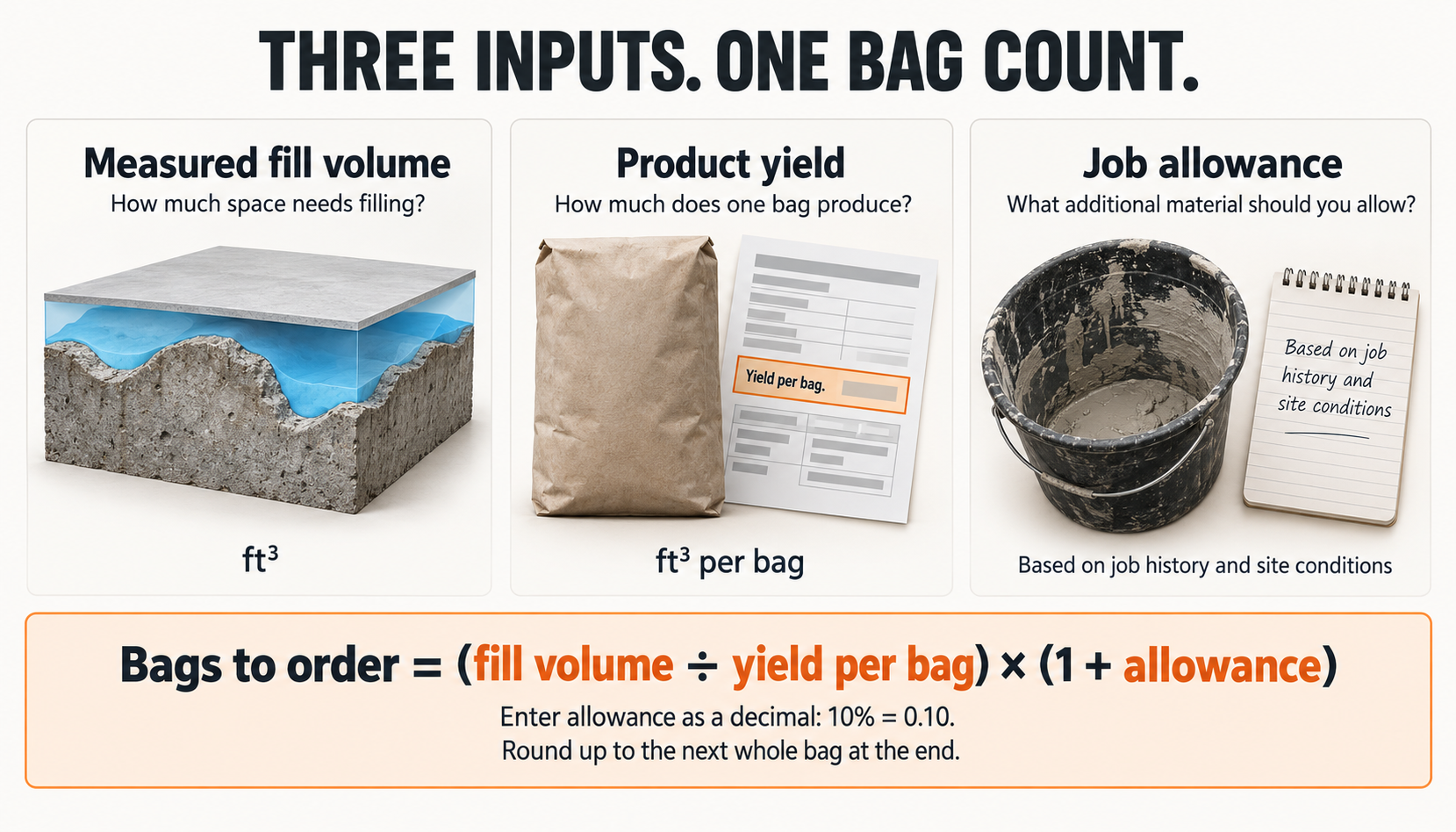
1. Measured fill volume.
This comes directly from comparing the floor's measured elevation against the selected preparation plane. The selected prep plane is the target elevation the finished flooring system requires. It should be a calculated cubic-footage figure, not a rounded estimate of "about how deep" the low areas look.
2. Manufacturer coverage rate.
Every self-leveling underlayment product has a published coverage rate, typically expressed as square footage covered per bag at a specific depth. For example, a bag might cover roughly 40 square feet at ¼" depth, and proportionally less at greater depths. This figure comes from the product's data sheet, not a rule of thumb carried over from a different product.
3. Waste allowance.
Some material is lost to mixing, overspill, material left in the bucket, and coverage of slightly more area than the strict measured minimum. A waste allowance built from actual job history is more reliable than a flat percentage applied without any basis. A percentage that's too low leads to a mid-job shortfall, and one that's too high inflates the estimate for no real reason.
Fill Depth Changes What You Use the Chart For
Coverage scales closely with depth for a given product, since a bag yields a roughly fixed volume of material, and volume is simply area multiplied by depth. Doubling the fill depth cuts the coverage area close to in half for most products. What doesn't carry over is the coverage rate from one product to another. A bag that covers 24 square feet at ¼" for one manufacturer's formulation won't necessarily match a different product's rate at the same depth. That's exactly why the figure needs to come from that specific product's current data sheet rather than an assumption carried over from a different one.
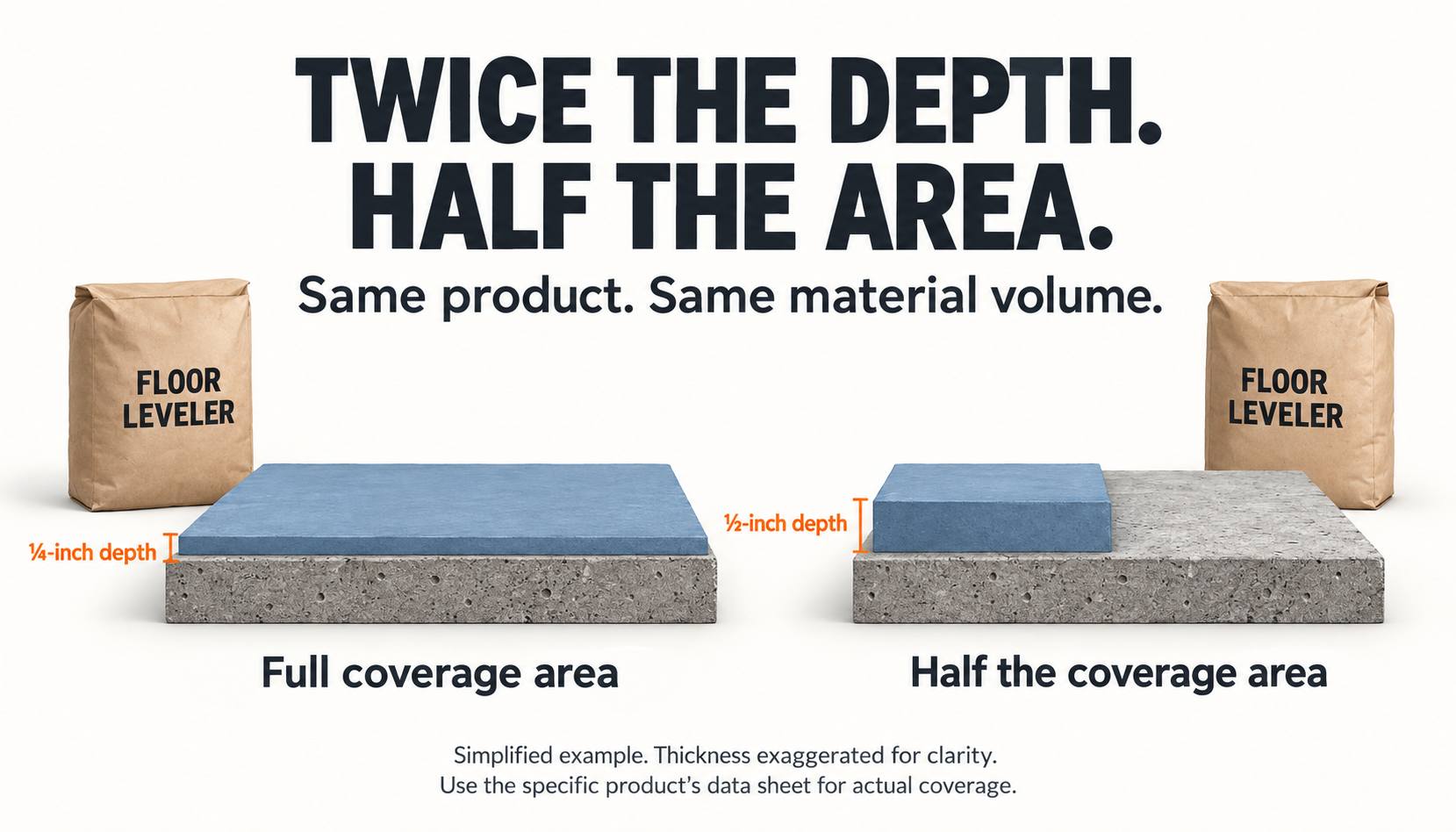
A conversion that applies a coverage rate printed for one depth directly to an area poured at a different depth will be wrong, even if the total volume figure was correct. The fix is working in volume, not a flat square-footage number. Calculate the actual cubic feet needed for each area, then convert using the bag's cubic-foot yield rather than its square-foot coverage at a single reference depth.
This is also where the earlier objection about multi-depth products applies directly. A floor requiring one product for deeper fill and a different product for a thin finish coat needs the volume split by depth range before either product's coverage rate gets applied, rather than one blended calculation across the whole floor.
A Worked Example
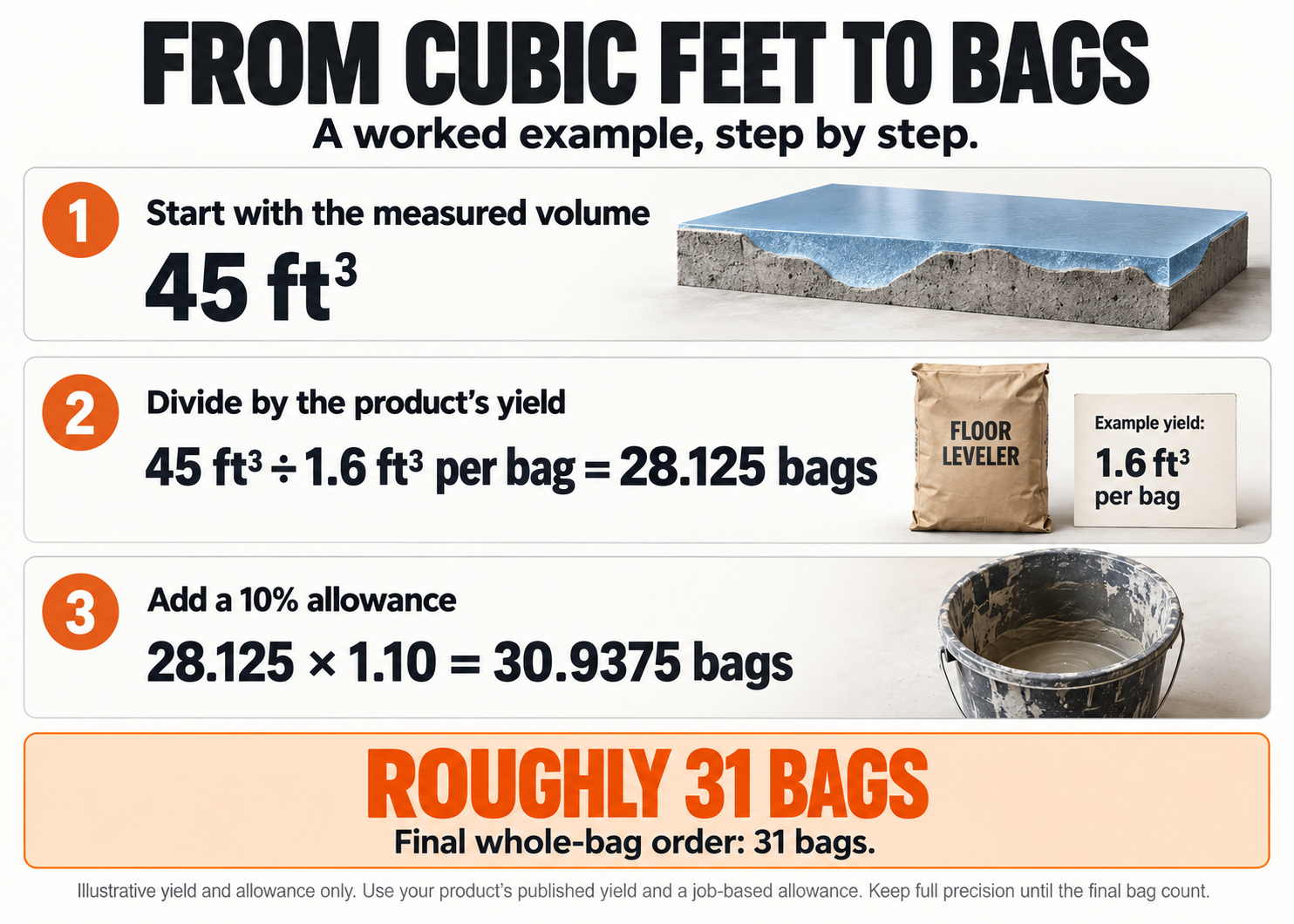
Say a measured floor requires 45 cubic feet of self-leveling underlayment to reach the target plane. The manufacturer's data sheet lists the product's coverage at approximately 1.6 cubic feet per 50-lb bag. Dividing 45 by 1.6 gives roughly 28 bags before any waste allowance. Applying a 10% waste allowance based on that contractor's job history brings the order to roughly 31 bags, a number built from three real inputs rather than a single estimated figure.
The exact yield varies by product. Sika's Level-325, for example, publishes 26 square feet of coverage at ¼" per 55-lb bag, a different figure entirely from the 1.6 cubic feet used above.
What Happens When the Conversion Skips a Step
Step Skipped | What Happens on the Job |
|---|---|
Volume estimated instead of measured | Order may be based on a rough visual guess than actual fill volume |
Manufacturer coverage rate assumed or rounded | Bag count doesn't match what the product actually covers at the specific depth |
Volume not separated by product when multiple products are used | Applying one yield rate to the combined volume can leave you short of one product and over-ordering another |
No waste allowance, or a flat one with no basis | Either a mid-job shortfall or an inflated, uncompetitive estimate |
How to Build a Reliable Conversion
Start from a measured fill volume rather than an estimated one. This is the step comprehensive floor mapping is built to provide.
Pull the coverage rate from the specific product's current data sheet, not from memory or a similar product used on a past job.
Split the volume by depth range if the project uses more than one product for different fill depths.
Apply a waste allowance based on real job history, adjusted for site-specific factors like access and crew experience with that product.
Digital measurement tools like SmartLevel can carry this further by exporting the measured floor data directly into a material calculation. This reduces the number of manual steps where a rounding error or an outdated coverage figure can enter the process.
Frequently Asked Questions
Why does the coverage rate need to come from the current data sheet?
A bag's coverage scales closely with depth for a given product, but the base yield differs from one manufacturer's formulation to another. A rate that's accurate for one product won't necessarily hold for a different one at the same depth.
Does more accurate floor measurement guarantee an accurate bag count?
No, measurement solves the fill-volume input, but the conversion still depends on an accurate coverage rate and a realistic waste allowance. All three inputs need to be right for the final order to be right.
How much waste allowance is typical?
It varies by product, crew, and site conditions. It’s best built from a contractor's own job history rather than a single industry-wide figure.
What happens with a floor needing multiple products at different depths?
The measured fill volume needs to be split by depth range before applying each product's coverage rate. Applying one blended rate across mixed depths produces an inaccurate quantity for at least part of the floor.
Key Takeaways
An accurately measured floor can still produce an inaccurate material order if the volume-to-bags conversion skips a step.
The conversion needs three real inputs: measured fill volume, the specific product's manufacturer coverage rate, and a waste allowance grounded in job history.
Coverage scales closely with depth within a single product. But that rate doesn't carry over between different products. So a floor needing more than one product requires the volume split by depth range before each product's rate gets applied.
Digital measurement tools can reduce conversion errors by exporting measured data directly into the material calculation.
Conclusion
Measuring a floor accurately and ordering the right amount of material are two different steps. Treating them as one is where otherwise solid estimates still go wrong. The volume-to-bags conversion deserves the same discipline as the measurement itself: real inputs, pulled from the actual product and the actual floor, rather than a carried-over figure from the last job.